

C'est Ah!
Socialized medicine is way cheaper (but be prepared to go topless)

We are now covered by the French health-care system. That’s right, we got us some genuine socialized medicine. A single-party payer. Universal healthcare. What Obamacare could have been if some Americans (you all know who I’m talking about, right?) didn’t get all freaked out about it.
Now, you won’t find many doctor’s offices in France with fancy furniture, posh waiting rooms or hospital gowns. There’s no soft rock playing over a speaker system. No receptionist on duty. My GP squeezes in exams while answering the phone to give medical advice and schedule appointments for other patients. She even has you dig the (bathroom) scale out from somewhere under a filing cabinet so she can record your weight.
It ain’t pretty, but it works.
Since I’ve been here I’ve had to undergo:
an annual exam by a general practitioner;
a TB x-ray and medical exam by the immigration service;
an ultrasound of my thyroid, and;
a mammogram to follow-up on a suspicious finding from an exam I had in the States just before we moved.
For our first visit to our médecin traitant, we weren’t quite sure where to go or what to do. There was no sign-in sheet, no receptionist and no other patients. We found our way to the dingy waiting room and, eventually, the high-energy, no-nonsense doctor stomped into the room and barked:
“Qui est le prochain?” (Who’s next?)
Her exam room looked like the cluttered, windowless office of an overworked college professor. She wanted to know why I was there, so I launched into my little speech about having just moved to France and needing a doctor so I found her name on an special medical app and made appointments to establish myself and my husband as patients so she could get to know us because we live here now and, did I tell you we moved to Rennes from the United States?
Well, she says, I’m retiring in March.
Oh. Will someone be taking over your practice?
I don’t know.
Can you recommend someone?
No. You probably won’t be able to find another doctor. There aren’t many doctors anymore. Now, take off your pants and find that scale under there.
Under where?
Somewhere under there.
Although gruff and obviously exhausted, the doctor spent over an hour with me, re-upping my prescriptions— for the next 1.5 years! — ordering the thyroid exam and filling out the reimbursement form so the government can cover most of the €25 cost of the visit. (That’s the equivalent of $27.06 as of this writing.)
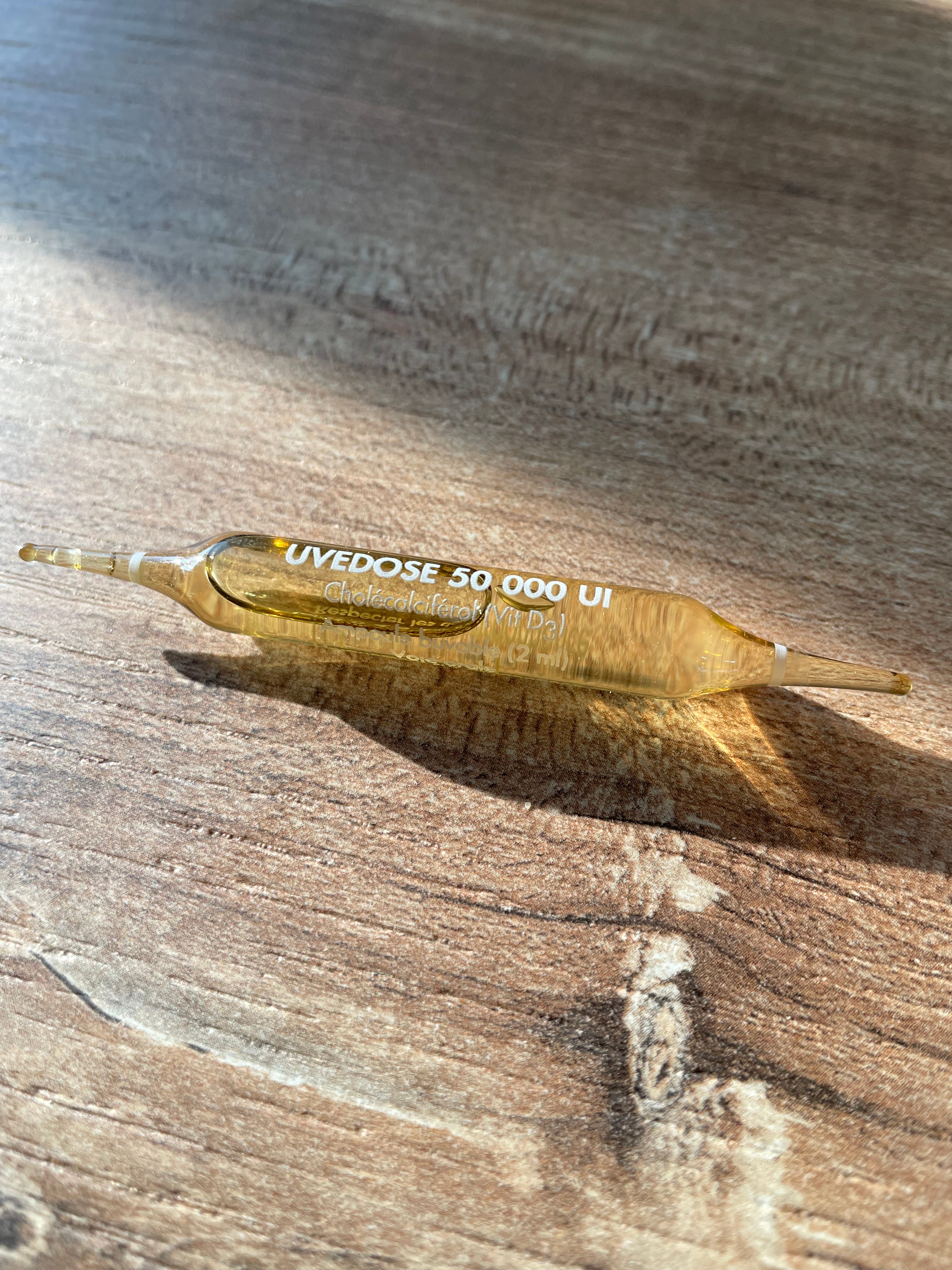
She also prescribed Vitamin D, which she recommends to all her patients in a monthly dose during the gray days between November and May. The supplement does not come in pill form, however. It is in a glass vial. To release the vitamin syrup inside, you actually have to break the little glass beaker. Break glass. With your hands. (It didn’t go well.)
As for the thyroid exam, it took more than two months to get in to see the radiologist she recommended. I went in, registered, showed them the prescription, then waited. For 45 minutes. After I was taken into the ultrasound room, I waited again. For 30 minutes. Eventually a technician came in and said something you really don’t want to hear when you’re scooching around on the exam-table paper: “Are you still here?”
I waited another 15 minutes.
None of that mattered after the radiologist came in, squirted gel on my neck, moved the wand around and — hold on to your $5,000 Blue Cross deductible — gave me the results as he was still doing the exam: “Fine. Normal. This is perfect.”
At home, I think I would’ve had to wait two or three days to hear the news.
I returned to the suitably named waiting room where I waited. For 50 minutes. Then I paid €34.97 for the ultrasound. (Estimated cost in the US: $300-1,000.) They gave me a document to submit for reimbursement. The French government will pay about 60-70 percent of the whopping 34.97.
Next up: Mammogram.
I had explained to the GP that, because genetic testing determined I am at high risk for breast cancer, my U.S. doctor routinely ordered a yearly mammogram plus a breast MRI. (Estimated cost in the US: $100-250 for the mammogram, $370-1000 for the MRI.) During the last MRI, just a few weeks before our move, the radiologist saw something that was “probably benign” but still wanted it checked again in six months.
My French doctor gave me a prescription for the mammogram. It took me more than two months — and a 30-minute drive in a car-share vehicle to a village inaccessible by public transportation — to see a radiologist. But the town had a medieval chateau, so that was cool. It also had amazing medical care.
I was instructed by a technician to take off everything above the waist. No hospital gown or thin paper bathrobe. Just me, some guy I just met, a mammography unit, and my naked boobs. And not just naked boobs while he was squishing them inside the machine, but naked boobs while I stood there waiting and chatting with him. Um, yeah.
The mammogram was normal, but because the radiologist couldn’t compare the images to other tests on a disk from Main Line Health, she decided to also perform a breast ultrasound, just in case. (Estimated cost in the US: $150.) There was no need for a pre-approval, no squabbling with my insurance company, no panic about being far from hitting my deductible, no waiting to make a second appointment.
She also added a traditional breast exam, apparently free of charge. Just to be sure. Again, I got the results (“parfait”) while the wand was still on my chest.
I paid €87. For all of it. That’s $94.16 for no-hassle exams that, without insurance, could’ve cost me over $1,000 in the U.S.
I collected the reimbursement form and the report and images to take home. In France, the hospitals and doctors’ offices don’t keep your x-rays and test results, which may not sound like a big deal unless (and I’m speaking as someone with firsthand experience here) you decide to move to another country, and they make you to sign a release form and nervously wait six weeks to get your hands on them. They just give them to you. Because they are yours.
I liked my US primary care doctor way more than I liked my French one. I felt more comfortable in the offices and waiting rooms at Main Line Health than I did in the dingy office on rue de Brest. They never had me get on my knees on a skanky rug to find a scale, and I certainly never had to stand around chatting with a mammogram technician looking like I was at spring break.
Healthcare is just about the least classy thing about the French (other than their apparent love for Jerry Lewis). Where their wine and cheese are refined and elegant, their medicine is unadorned and dingy.
But it works. It’s cheap. And, most importantly, it is universal. Everybody, even the people some Americans believe don’t deserve free medical care, get it anyway.
As always, a wonderful, post, Theresa! I see some parallels with my experiences in the US--and of course the very real differences you note! For one, I often have orders approved quickly, but to get an appointment to fulfill the order, that's another matter. Most of my doctors are part of the faculty at GWU Hospital, so everything is right there---including all the testing equipment MRIs, Xrays, and so forth. But I can wait a long time to get an appointment for one of these. The lab work, however, is quick, with results coming in often the next day.
médecin traitant is a general practitioner. Traitant is the gerund of the verb traiter, to treat