

I Don't Get It
Joking around is part of the elusive sense of belonging in your new country

In the French cult comedy, “Bienvenue chez les Ch’tis,” (“Welcome to the Sticks,”) we follow the main character grudgingly making his way from the sunny south to his new job in the dreary north of France. Just as he drives past a road sign welcoming him to the department Nord Pas-de-Calais, a deluge of rain slams his windshield.
I was hysterical because it’s true: It rains with uncommon enthusiasm and frequency here in the north and northwest of France.
I realized at that moment – sitting on my French couch in front of my French TV, drinking some French wine and laughing a big, American guffaw – that this was the first time I really felt in on a French joke. It was like being invited to sit at the cool cafeteria table in high school.
Then I went to Yoga class. Everything was perfect until after class, when all the other yogis started gabbing and laughing. The humor, the slang, the shared references, the clipped words flew past me quicker than you could say “Namaste.”
I began to ponder the interplay between my movie and Yoga experiences. I wondered how important getting the gag and knowing the cultural call backs were to having kinship with the French. Can a person who spent decades living in the same US neighborhood establish roots after just a few years in a foreign city?
What does it mean to belong?
I have a lot on my side in the effort to belong. I speak the language. We’ve made our apartment feel homey. I know my way around the city. I have our regular boulangerie, supermarket, doctor, massage therapist. I’ve made lovely friends, both French and non-French. I read the local news, have my weather apps set to my location, and have located all the ATM machines. I’m used to the money and even getting accustomed to the Celsius and the damn Metric system. I know which vendors sell the best veggies and who bakes the perfect baguette. I’ve even found my favorite chocolate bar. (Lindt dark chocolate with Fleur de Sel. You have to try it. Really.)
Still, I feel out of the French loop.
Of course, the most official step toward integration requires more than the ability to roll your Rs. You need that burgundy-colored passport. Obtaining naturalization, an arduous and lengthy task I was more than willing to tackle, now seems impossible. Obstacles loom on both sides of the Atlantic.
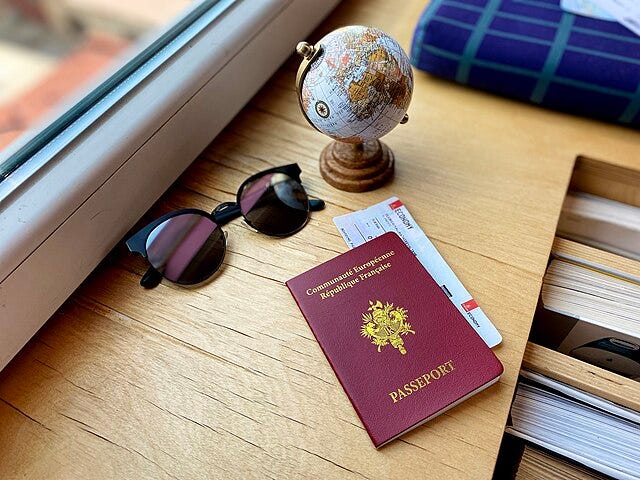
In the US, the Exclusive Citizenship Act, proposed by U.S. Sen. Bernie Moreno, (R-Ohio) would forbid dual citizenship. Although it seems unlikely to pass, the bill paints those who feel a kinship to two countries as lacking the loyalty worthy of the United States. As if citizenship is the only way to prove loyalty.
The more troublesome impediment recently came from French Interior Minister Bruno Retailleau. In a memo published last year, Retailleau clarified that applicants for French citizenship must receive the majority of their income from French sources. That excludes non-French pensions and Social Security payments many retirees live on. I may eventually qualify but the road will be a doozy. First, I have to wait two more years until my residency card permits me to work. If I can find a job in 2027, I’ll need to plug away at it until I’m 70 and reach the 5-year employment minimum required to apply for citizenship.
The citizenship news threw a gut punch at retirees who could otherwise meet the necessary qualifications. It certainly added an unwelcome snag to the concept of belonging. It also forced me to picture myself teaching Yoga at the age of 70. I cannot unsee that.
Of course, loyalty, inclusion and acceptance aren’t guaranteed by naturalization or legal residence. (See: United States of America, circa now.) There’s also an existential quality to the sense of belonging. An awful lot of it has to do with shared experience. Common touchstones. That almost seems more elusive than the French passport.
I sought advice from a beloved French teacher.
“The struggle is real,” Véronique Savoye told me. “You will never replace the years you did not spend growing up in the adopted culture. There are experiences you never had, TV shows you never watched, ads you never knew. Some made it to the Big Leagues: Everyone around you knows cultural references and quotes them on a regular basis. They can feel like private jokes you aren’t meant to understand.”

I’ve made inroads toward familiarizing myself with cultural cues by attending Véro’s “French Bootcamp” discussion group for the last four years. Our class – small and filled with fun and interesting people who love France – is not just a 90-minute chat. Véro has us preparing days ahead with videos, articles and discussion points on fascinating aspects of French history and culture that often run under the radar. I’ve learned about the history of the CanCan, the famous Resistance boss Jean Moulin, regional foods, fairy tales, holiday celebrations, treasured songs, poems, iconic clothing, heroes, and actors.
Each cultural dive adds another layer to my understanding of what it means to be French. Still, Véro admits, there is no quick fix to fitting in.
“There are hours devoted to studying another culture, especially through its language including grammar and pronunciation rules,” she said. “The next step is immersion in daily life and activities, whatever they may be, to watch how people in the adopted culture speak or behave. The goal: interacting with natives in a meaningful way.”
I remembered Véro’s advice about meaningful interactions with natives when I met my friend Inès for coffee. As we were chatting, she said something that didn’t make sense: “Ça ne mange pas de pain.” What now? It doesn’t eat the bread? She explained that it’s an old expression that means “It doesn’t cost anything.” The French take on “It can’t hurt.”
According to Véro, those chats with friends, the questions for clarification: it’s all part of the process.
“Moral of the story: Sense of belonging can come with baby steps, a humbling experience,” she said. “Seize the opportunity: Realize the learning process never ends. Ask questions, a lot of them, whenever you feel you are missing something. Many people will volunteer to answer them, because they are culture-proud and flattered by your interest. Once you get a cultural reference, you, too will be in on the joke.
“You, too, will feel like you belong.”
Well, dear French student (and francophile,) thank you for quoting this adult educator with a foot in two cultures for the last 30+ years who is still trying to figure things out herself. Yes, recognizing (humbly) you are no expert, just a lifelong student, asking questions, stubbornly, relentlessly is one way to understand our adopted culture of choice and ultimately to feel like we belong. As for naturalization, officials (and rules) do change. Stay hopeful and dig into that famous American optimism. It might very well happen (and without having to perform a Scorpion pose in your 70s! ;-)
This may have been your best entry yet. There have been pieces more entertaining, more emotional, more funny, more informative. This one was the most realistic. A bucket of that cold Brittany rain right in the face.