

Sharing Is Caring
How I gave up car ownership and discovered autopartage

The day I bought my first car was the best day of my life. I’ve had other best days since then, but this was a biggie. It was a red 1977 Datsun B-210 hatchback. Cost me thirty-seven hundred bucks plus interest on a 3-year loan co-signed by Dad. After years of borrowing the family sedan (and wrecking my sister’s Ford Maverick), I finally had my own set of wheels. I drove it out of the dealer’s lot, cranked up the tinny FM radio, headed home… and stalled out on the first hill.
It was a clutch mistake by a stickshift noob. Or maybe it was something more. Because – after persevering through a half-dozen cars (and one pickup) over the next 45 years, through daily commutes and two-hour traffic jams on the Atlantic City Expressway, past occasional fender-benders and stolen hubcaps, from the days when 5 bucks would fill the tank to the days when that wouldn’t even get me a gallon – I wonder if stalling out was an omen.
Was the universe telling me that this was just Day One of a lifetime of hassle?
I dunno, but I do know that the day I sold my last car was an even better day. And not just because I was unloading a crappy (red, again) Hyundai Tucson. On this day, I moved to France and – thanks to the wonder of autopartage – gave up car ownership for good.
Car-sharing has changed my life more than anything else in France, and that includes my newfound addiction to Bleu des Causses. I know it’s not for everybody, especially if you live outside of a city. But I’m sharing my experience here because I think it says a lot about why we enjoy our lifestyle in France.
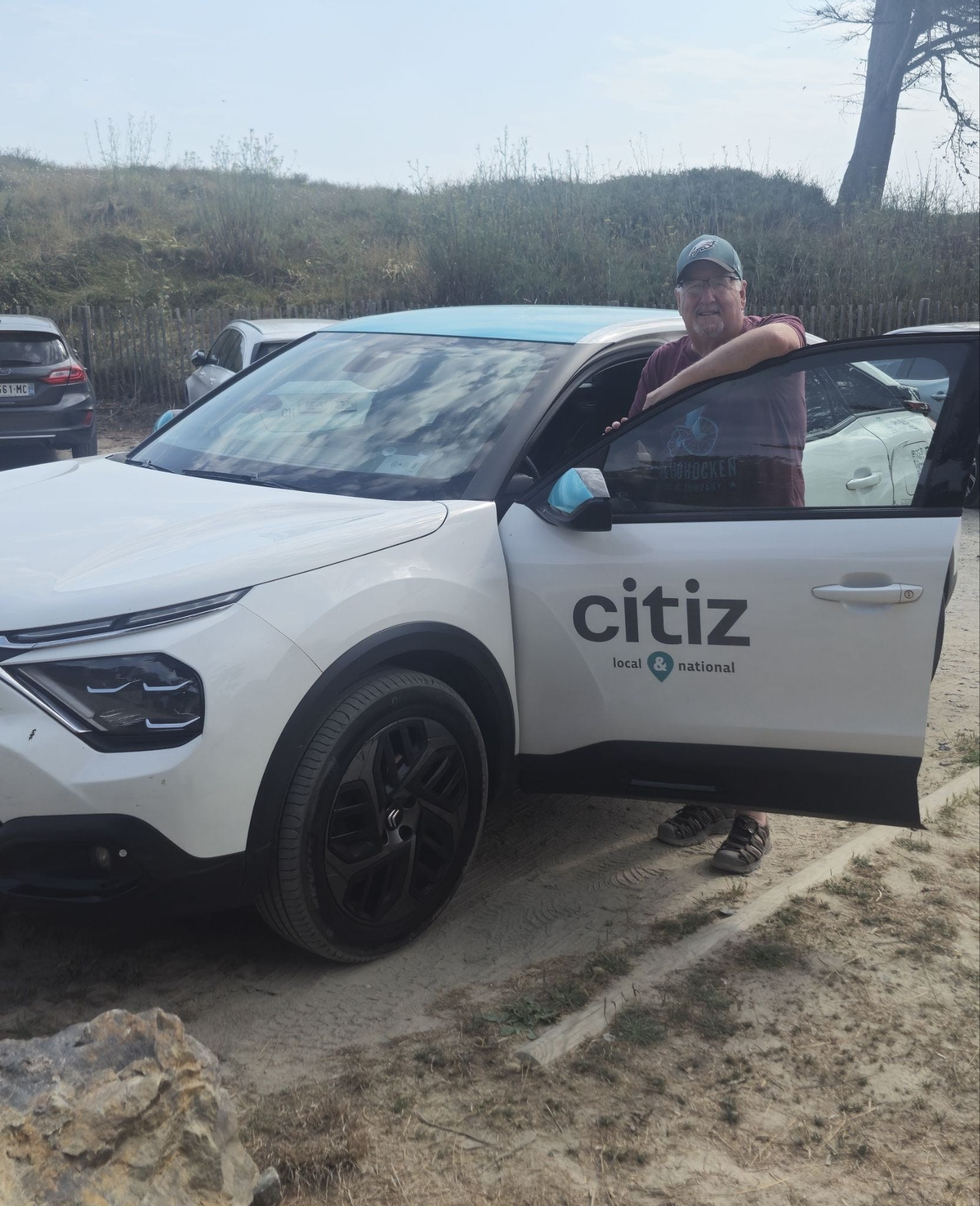
Our car-sharing service is called Citiz. It’s available in Rennes and 250 other cities across France. It’s like Zipcar in America, where you become a member and use an app to reserve and unlock cars that are strategically parked around the city.
I never used Zipcar back in Philly because the nearest available car was a 45-minute walk from my home. I could’ve taken a bus there, I guess, but it ran only once every 30 minutes and its total disregard for schedules made it the worst route in the city.
Citiz, meanwhile, has 10 cars parked within a 5-minute walk of our apartment. The only time I’ve walked further was to grab a small van to move some furniture. (The agency supplies mostly small SUVs and hatchbacks, plus some large passenger vans and even cargo velos.)
True, I’m forgoing the luxury of having my very own car waiting for me in my very own driveway. Also, the cupholders aren’t big enough. But the tradeoff is huge.
And by huge, I mean about $7,500 a year. That’s how much I’m not spending on a car loan, insurance, maintenance, car washes and fuel (at an average of €1.95 per liter, or $8.50 a gallon). Citiz sends someone out weekly to inspect and clean each car. It handles repairs and replaces vehicles when they get old. There’s a credit card in each car’s glove compartment that I can use at any gas station. Citiz only asks me to make sure the tank is at least one-third full for the next driver.
My costs? I pay a membership fee of €15 a month that covers my insurance and the agency’s costs, plus €2-4 per hour, and another 20 to 50 cents per kilometer. The rates vary depending on the time of day and the length of your use. A two-hour sprint to the beer distributor and our favorite home goods store costs about €10, for example. A day trip to Normandy and back runs me about €145. (That might sound steep, but remember: I don’t pay separately for fuel or insurance, and I don’t have to stand in line at the rent-a-car kiosk.)
Last year I spent €1,377.70 on Citiz. That included our membership fees, various chores about 2 or three times a month and several long trips, including a weeklong, 1,500-kilometer trek to Massif Central and back (€500).
But this is not just about euros and cents. There are intangible benefits.
For one, without the ready availability of my own car, I frequently opt to walk distances that I once drove. In Philly, it was not uncommon for me to hop in the car for a 3-minute ride to pick up prescriptions at the CVS; in Rennes, I find myself walking an hour for a doctor’s appointment. Those walks do wonders for your outlook on life: You’re not bottled up alone inside your car, you’re part of the city, among your neighbors.
I know this sounds touchy-feely, but in using Citiz, I’m part of a large network of fellow Frenchies who have decided to give up our cars for the common good. It’s a literal manifestation of fraternité, which is precisely the reason I moved here.
It’s estimated that each Citiz car replaces up to eight personal cars. That’s a lot of parking spots. Can you imagine the impact it could have in a neighborhood like South Philly, where there are so many cars, the locals are forced to park them in the middle of Broad Street?
Of course, you can’t. Because owning your own car is the American Dream, right? Well, I miss hot dogs and baseball, but not my own car. Chalk that up as something else I left behind.

Couldn't agree more! In the US public transportation is often something to be endured. In Paris (in particular) it is a constant source of pleasure, at least for me. Every ride on a bus or in the metro is a story, every station an adventure. And then, on the rare occasions I need a car, sharing or renting affords the advantages of driving without the headaches of ownership. I'm pretty sure that when the French Revolution added "liberté" to the national motto, they were talking about freedom from owning, insuring, and maintaining an automobile.
I've lived in Europe for 6 and 1/2 years without a car. And I've lived in France for 4 and 1/2 years without even a driver's license! So, no rentals.
I loved driving. I always drove a stick shift from my very first car, which was a 1964 Simca, a French car! Who knew? When the car broke down, which was every other week, I would just put my foot outside the door and push. 😂😂 For the rest of my driving life of 55 years, I almost always drove stick shifts by choice.
But for the last 4 and 1/2 years no car, 😊 no problem!