

Zoned Out
Does anyone know what time it is? Seriously: What the hell time is it now?

I have two internal clocks: one follows the time in France and the other monitors the East Coast of the United States. This is necessary when I have to call our US bank, schedule an online class with my US-based French literature teacher, or catch up with a friend.
My issues with the clock go way back. Let’s just say that many 6-year-old tears were shed trying to learn how to read one. Eventually I figured it out, only to revisit that trauma during my early courtship with Don – the son of two world-class pranksters – who reset all the clocks in my apartment after I had turned them back for Eastern Standard Time. I ate lunch an hour early before finally catching on several days later.
It’s a good thing my morale has been stabilized by a degree of success in the world of words, because when it comes to numbers, or anything vaguely math adjacent, I lose a little bit of my soul. Time zones definitely fall into the soul-depletion category.
When I think about it all philosophically, I can roll with the idea that we divide the world up into 24 different time zones so we can all have a level playing field in chasing the sun. That makes it all seem like a meaningful way of engaging with reality.
Still, I need to count on my fingers to figure out what time it will be in France when customer service opens at Bank of America. Eight a.m. plus six hours equals 2 p.m., then, just for fun, add the 1200 to turn that into the military time we use here.
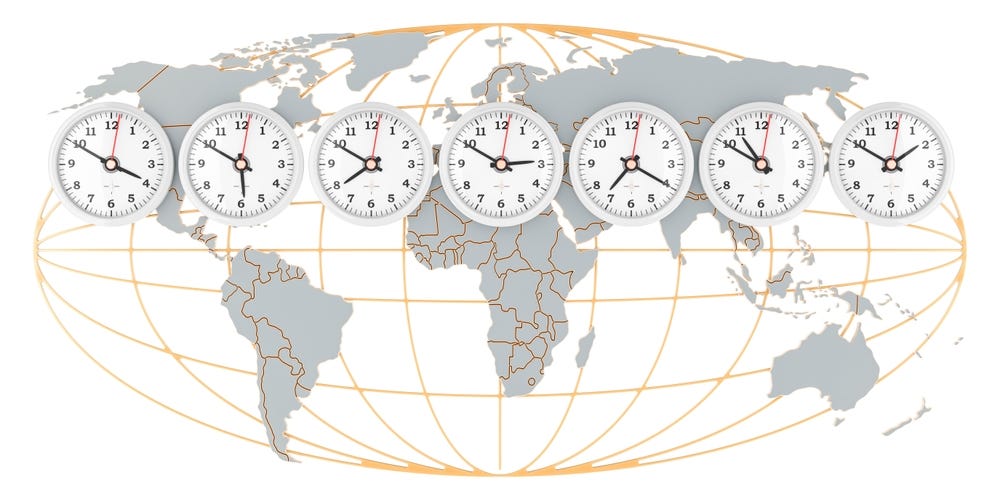
About the time when I’m feeling in the swing of the plus-or-minus 6 hours thing, they go ahead and change the clocks. Now it’s not just a math problem. It’s an existential pickle. I have a complete mental block in grasping whether I am passing through this world one hour ahead or one hour behind customer service at Bank of America. The befuddlement arrives every single time we change the clocks, just like it does every time I watch The Matrix.
It doesn’t help that this is not a tidy system. Not everyone observes the spring shift to Daylight Savings Time (DST) and the autumn fall back to Standard Time. In the US, Hawaii and most of Arizona don’t change the clocks. Neither do some US territories like the Virgin Islands, Samoa and Puerto Rico. The continents of Asia and Africa also opt out, as do Azerbaijan, Iran, Jordan, Namibia, Russia, Samoa, Syria, Turkey, Uruguay and most of Mexico.
There’s also no worldwide memory key to remember which direction to go in. “Fall back, Spring Forward,” for instance, doesn’t work here in France. The double meaning in English of the words spring and fall land flat in a country that uses printemps and automne. Our local online news source, Actu Rennes, offered a mnemonic for its French readers. It uses the “re” in Octobre and the “av” in Avril (April) as prompts. They said the trick has been under the radar for years. Based on their explanation, I can see why:
Le voici : en automne, on recule d’une heure. Pourquoi ? Parce qu’on est en octobre. En octobRE, ou REcule. Et en mars, on… On arrive bientôt en avril ! Et en AVril, on AVance d’une heure. Mais si vous avez retenu le premier, vous pouvez aussi procéder par déduction. Quand on s’approche de l’hiver, on gagne donc une heure de sommeil, de quoi rester un peu plus longtemps au chaud sous la couette. En été… On profite un peu plus du jour qui devient plus long.
Translation:
Here it is: in autumn, we go back one hour. Why? Because it’s October. In October, or move back. And in March it’s almost April! And in April, we move forward one hour. But if you retained the first, you can also proceed by deduction. When we approach winter, we gain an hour of sleep, enough to stay warm under the duvet for a little longer. In summer... We take advantage of the longer daytime.
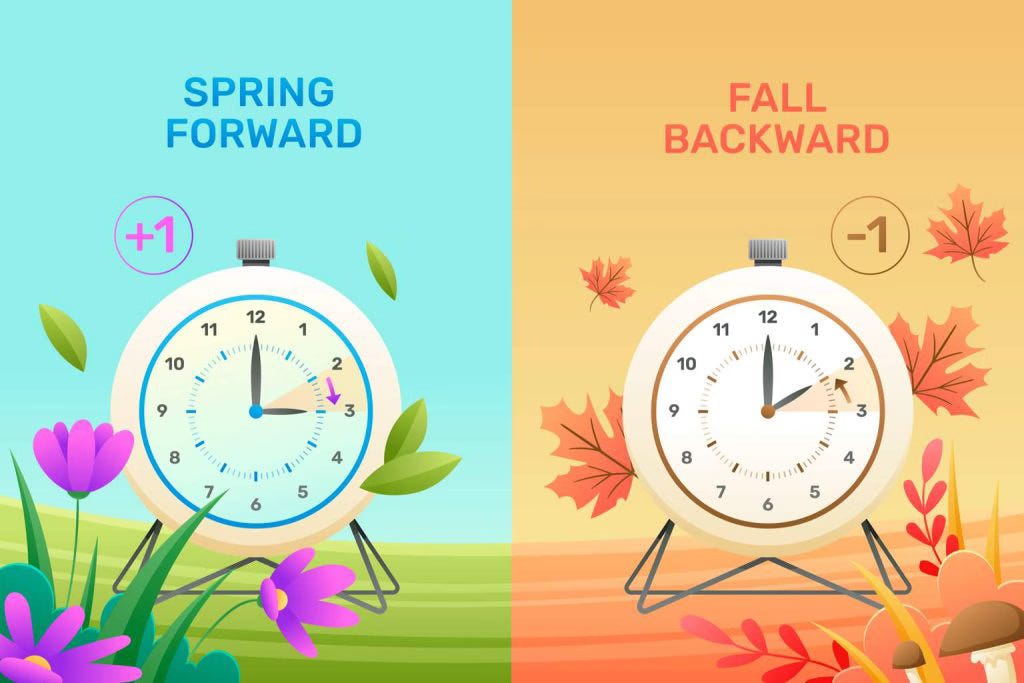
Even among the places on board for adjusting the clocks twice a year, there is no global agreement on exactly what date to fall back or spring forward. This year France a reculé one hour on October 26. The US won’t do the same until November 2. So for one week in autumn I routinely feel a stroke coming on as I try to figure out whether that means France has a 7- or 5-hour difference from the US. (It’s 5 hours, and I’m leaving this right here so I can come back and refer to it next year.)
Things get even worse in the Spring, when the US changes the time on the second Sunday in March but France waits for the last Sunday. For two weeks we are either, I don’t know, 7 or 5 hours different from eastern United States.
The rationale for DST, or summer time, is to save energy. Here in Rennes, in the west of France, the sun rises just after 6 a.m. in the height of the summer, and doesn’t set until after 10 p.m. True darkness doesn’t really take hold until about 11. So, yeah, we don’t need to keep the lights burning long, but I do have to run around the apartment adjusting the electric blinds so I can fall asleep.
In winter, when the sun doesn’t rise until 9 a.m., I use up all the energy I saved in summer by constantly charging my headlamp for the pitch-black morning walks.
I know this isn’t exactly the worst problem to have in the land of extraordinary cheese and warm baguettes. The worst problem is not being able to watch the Philadelphia Phillies and Philadelphia Eagles play in real time.
Most games are played while we are asleep, so Don doesn’t catch the score until he wakes up the next morning. This informs him on whether it’s worth watching the highlights, or even the whole game, on tape delay. If either team is in the playoffs, however, we must observe complete radio silence – no phones, no news, no spoilers – until after he has watched the entire game over breakfast. If I have snuck a peek at the scores before he wakes up, which I usually do, I must avoid all eye contact.
There are some magical moments in this episode of The Twilight Zone, like when an afternoon game on the East Coast allows us to watch live in the evening. We can eat dinner in front of the TV and delight in being, if not in the same time zone as other fans, at least on the same wavelength. And then there are the once-in-a-lifetime treats, like the other day when we woke up to find the previous night’s World Series game still going on – in the 17th inning!
Beyond all the confusion and the math, however, I hold a private, little soft spot in my heart for time zone variations. When I was a homesick teen on my very first trip to Paris, I somehow found immense comfort knowing that, when I was awake my parents were asleep and while I was asleep, they were awake. Somehow, in my 19-year-old brain, that made me miss them less.
When I have that wave of homesickness for loved ones I’ve left back in the US, that little trick still works.
I just put all the relevant cities in my life on the Weather app and check the time difference there. Sydney is better for baseball. World Series game 6 starts at 11 am. Go Blue Jays!
The EU has been talking about eliminating the time change for years, but the years roll by and nothing happens. The main argument seems to be that it throws people's internal clocks off and causes accidents. I personally like the time changes in general. But it is annoying when the US and Europe don't change at the same time.