

It's About time
Too early, too late. . . just right

I cannot be late.
I have tried to be laissez-faire about time, considering it a mere suggestion – relative, and all that – but it doesn’t work. I am compelled to add a comfortable buffer of time onto everything I do, just in case I’m delayed by a missed bus or sudden tornado.
This often means I arrive early and must cool my heels on some crummy bench just far enough away from my destination to hide my premature punctuality. Sometimes the bench is covered in bird shit. But at least I’m not late.
While my promptness is a clear asset for important appointments, like picking up my residence permit at the prefecture or getting an MRI, it can be somewhat of a liability for social engagements. It makes me come off as a bit too eager. Even worse, I may seem impolite.
There’s this French “cultural norm” I’ve read about that requires guests to abide by the rule of le quart d’heure de politesse. The quarter hour of politeness is a courtesy whereby you arrive at someone’s house at least 15 minutes past the time on the invitation. Supposedly, this allows the host a few minutes to settle down from party preparations and leisurely await the arrival of guests.
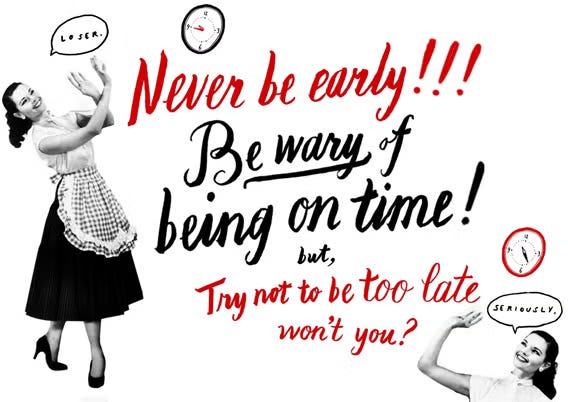
I dislike this rule for two reasons. The first is obvious: If you want people to arrive at 7:15 p.m. instead of 7:00, then just say that when you invite them. Or, time your party prep to conclude at 6:45, and give yourself that quart d’heure de politesse. Consider it self care.
Mostly I detest it because of that thing where I cannot be late. That 15 minutes technically made me late, no matter what some rule of French civility says about it.
I also can’t get past the fallout from this 15-minute edict. See, there’s another rule of politeness that dictates the host wait until all guests have arrived before serving any cocktails. If I am already strung out from getting to your house 15 minutes late, I pretty much want that drink in my hand before I take my coat off. I’ve had enough anxiety for one night.
In my heart, I suspect this law of imposed tardiness is about as legit as the antiquated guidelines about not wearing a baseball cap, never speaking above a whisper, or – god forbid – drinking coffee-to-go in France. I haven’t been invited to enough social events to conduct a legitimate data analysis, but my unscientific observation thus far reveals that the 15-minute thing is bullshit made up by some French socialite lacking time management skills.
You have to wonder, though, because we have witnessed similar “cultural norms” concerning punctuality.
I’ve been to more than one boulangerie at opening time, only to wait outside as the crew finishes setting up for the day. Most of the time they are not more than a few minutes late. Even I can deal with that. Sometimes, though, they take longer. That can get awkward, like the time I, standing at the door like a nervous kindergartener, had to ask if I was allowed to enter since it was well past 7 a.m. The woman glanced at her watch, harrumphed and finally unblocked the doorway. Maybe she was expecting le quart d’heure de politesse?
There’s also the unfortunate tale of Don’s favorite beer bar.
The 400 Coups (400 Blows, named after a Truffaut film) had inconsistent hours. To put it mildly. According to the sign on the door, the bar, just across the street from us, opened at 5 p.m. Except not always. Don, who would set up a stakeout from our window, once mentioned to the bartender that he knew the bar was open because he saw her arrive. That’s when she felt the need to set him straight about the business hours posted on the door: Those hours do not indicate when the bar is open to the public, she said, but show the time she is supposed to arrive for work.
The bar closed just a few months later. Wonder why.
Add this unusual interpretation of “business hours” to delivery people not showing up because “something happened,” workmen arriving hours (or days) after their scheduled time, or stores posting a handwritten note on the door to let us know that today there is une fermeture exceptionnelle. (An unusual closing.)


You might think this adds up to a country operating on the mere suggestion of time. That would be infuriating to a time cop like me. Except that it’s actually one of the things we love about France.
The way the French loosen their grip on rigid work standards is an admirable, healthy trait. We’ve seen the benefits of the country’s attitude toward maintaining work-life balance: Workers enjoy a greater sense of well-being while still maintaining productivity. Their attitude has even been codified by laws governing limits on working hours and the protection of leisure time. It’s one of the reasons so many Americans intent on fleeing the US have chosen France as their new home.
It’s tough getting used to this attitude after spending your life in a country that values doing over being.
Colleagues here, however, routinely enjoy a three-course lunch on a sunny restaurant terrace on a random Tuesday afternoon. Parents forgo the ease of a stroller to slowly walk beside their toddler. In just a few years, they will spend that time teaching the little one to ride a bicycle safely through the city’s bike lanes, while they offer instruction and encouragement.
They linger in cafés, amble through bookstores, wait patiently for the next metro, let you in line in front of them at the grocery store, take five weeks of vacation, close down their shops on Sundays, stroll by the river, play pétanque, and savor meals. They even have a verb – flâner – to describe the act of strolling without purpose.
So, yeah, I am willing to let the workman slide and wait a few more days for the delivery.
Just don’t expect me to show up late for cocktails.
I thought about not 'liking" this so soon after you posted this, not wanting to appear too eager to let you know how much I love your writings, but what the heck. I love your articles, and Don's too!
Hello Theresa. Such a fun but true portrayal of the time management protocol in France and how it differs from that on the East coast of the US particularly in Philadelphia. As someone who lived in PHL and has enjoyed many extended stays in various parts of France, the differences are striking at first but become fun to embrace. I have a Brother in Law who has had some business dealings with French companies and he just doesn’t understand how they are closed for the month of August or extended holidays. I’ve given up trying to explain the cultural differences. I am grateful that I have experienced these differences.
All best to you. Joseph D.